

Deciding Together
The best free wishlist apps in 2026
Six free wishlist tools people actually use, what each one gets right, and where it falls short if you're furnishing a home together
Deciding Together
Most of these apps are built for one person's Pinterest board, not two people trying to agree on a sofa, here's what the good ones get right


Search for “furniture wishlist app” and most of what comes up is built around one person: a mood board, a saved-items list, a Pinterest board with better filtering. That's fine if you're furnishing alone. It falls apart the moment there are two of you, because a couple's furniture list has to do more than remember what you liked, it has to get you both to agree on it.
Here's what actually matters if you're choosing one of these tools together, based on where the single-person versions tend to break down.
| What to look for | Why it matters |
|---|---|
| No single owner | You both use it as equals, with nobody's login in charge. |
| Real, independent voting | Each person's yes or no is clear, so disagreements show up early. |
| A “maybe” option | Undecided items stay visible instead of getting a rushed answer. |
| Prices kept with each item | The number behind most arguments is never left to memory. |
| Organised by room | Lists and totals follow how you actually furnish, room by room. |
| Still tidy at forty items | Filters and at-a-glance status matter once the list grows. |
| Room for more than two people | A flatmate or parent can join in without breaking anything. |
| Works well on a phone | You can react the moment your partner finds something. |
| No shopping inside the app | You browse retailers as normal and just paste the link. |
Most wishlist tools belong to whoever signed up. If it's attached to your partner's Amazon account or your Pinterest login, you're a guest in your own furniture decisions, dependent on them sharing access properly and keeping it shared.
A furniture wishlist for a couple should belong to the couple, not to whoever happened to create it. A shared link that neither of you has to log into is a much lower bar to actually both using it.
Hearts and likes are built for social validation, not decision making. They don't distinguish between “I love this” and “I'm fine with this”, and they definitely don't capture “absolutely not”.
A proper couple's furniture wishlist needs a clear up or down from each person on every item, cast independently rather than by scrolling together and reacting out loud. That's the only way to actually surface disagreement while it's still cheap to resolve.
Not every item gets a clean answer straight away. You might like the rug but need to see the sofa fabric first, or you're genuinely torn and don't want to commit to a no you might regret. Forced into an immediate yes or no, people tend to answer carelessly just to get past the question, and a careless answer is worse than no answer at all.
A proper maybe, sitting alongside the yes and the no, keeps genuinely undecided items visible instead of burying them under a false verdict neither of you actually meant.
A saved image is only half the information. Without the price attached at the point you found it, you're relying on memory for the number that causes most furniture arguments in the first place, and it's exactly how couples lose track of the sofa they agreed on three weeks later.
Whatever tool you use should keep the price next to the item, update-able as you go, so a running total is always roughly visible rather than a surprise at checkout.
A flat list of forty saved links in the order you found them is unusable within about a week. Furnishing a home happens room by room, budget by budget, and the tool should reflect that structure rather than fighting it.
It also makes the running total worth looking at. One combined number tells you nothing about whether you're overspending on the living room and starving the bedroom, but a per-room breakdown flags that the moment it happens, not after everything has already been ordered.
A handful of saved items is easy to hold in your head. By the time you're actually furnishing a flat, that list is often forty or fifty items long across five or six rooms, and a tool that only feels tidy when it's small starts actively getting in the way right when you need it most.
Being able to filter by room, or see at a glance what's still undecided, matters far more than it seems to when you're only trying the app out with three items in it.
Plenty of moves involve more than a couple, a flatmate, a parent contributing, someone crashing on the sofa for a month who still gets an opinion on the sofa itself. A tool that hard-codes exactly two users breaks the moment your situation is slightly less standard than that.
Retrofitting a third person into a two-person system is rarely graceful once you actually need it. Either everyone shares one login and you lose track of who said what, or the tool simply won't let you add them, and you're back to a group chat and a spreadsheet for the one person who doesn't fit.
Most furniture browsing doesn't happen at a desk. It happens on the sofa, half-watching something, one of you scrolling and the other glancing over when something's worth a look. A tool built for a laptop screen with mobile bolted on afterwards doesn't match how couples actually shop.
It matters for the voting too. The moment you find something is usually also the moment you want the other person to react to it, not an hour later once you're both back at a computer.
You'll still browse on the retailer's own site, that's where the sizes, reviews and delivery dates live. The wishlist's job is to catch what you've found and hold it somewhere shared, not to replace the shops themselves.
Tools that try to do both usually do neither well, a half-built product catalogue with none of the retailer's actual stock data, or a browser extension that breaks the moment a site changes its layout. Pasting a link and letting it fetch the basics is a much smaller, more durable promise to make.
Every one of these is a fairly ordinary thing to want. Generic wishlist tools just weren't built to do it, because they were built for one person deciding, not two people agreeing. If you want to see how the popular free options actually compare on this, we've reviewed them in the best free wishlist apps in 2026.
Most of what's above boils down to one test: can you tell, at a glance, what you've both actually agreed to? Furnish Together is a free furniture wishlist app for couples built to pass it, with independent votes on every item, organised by room, and nothing to set up or remember to check. See the full feature list if you want the specifics.
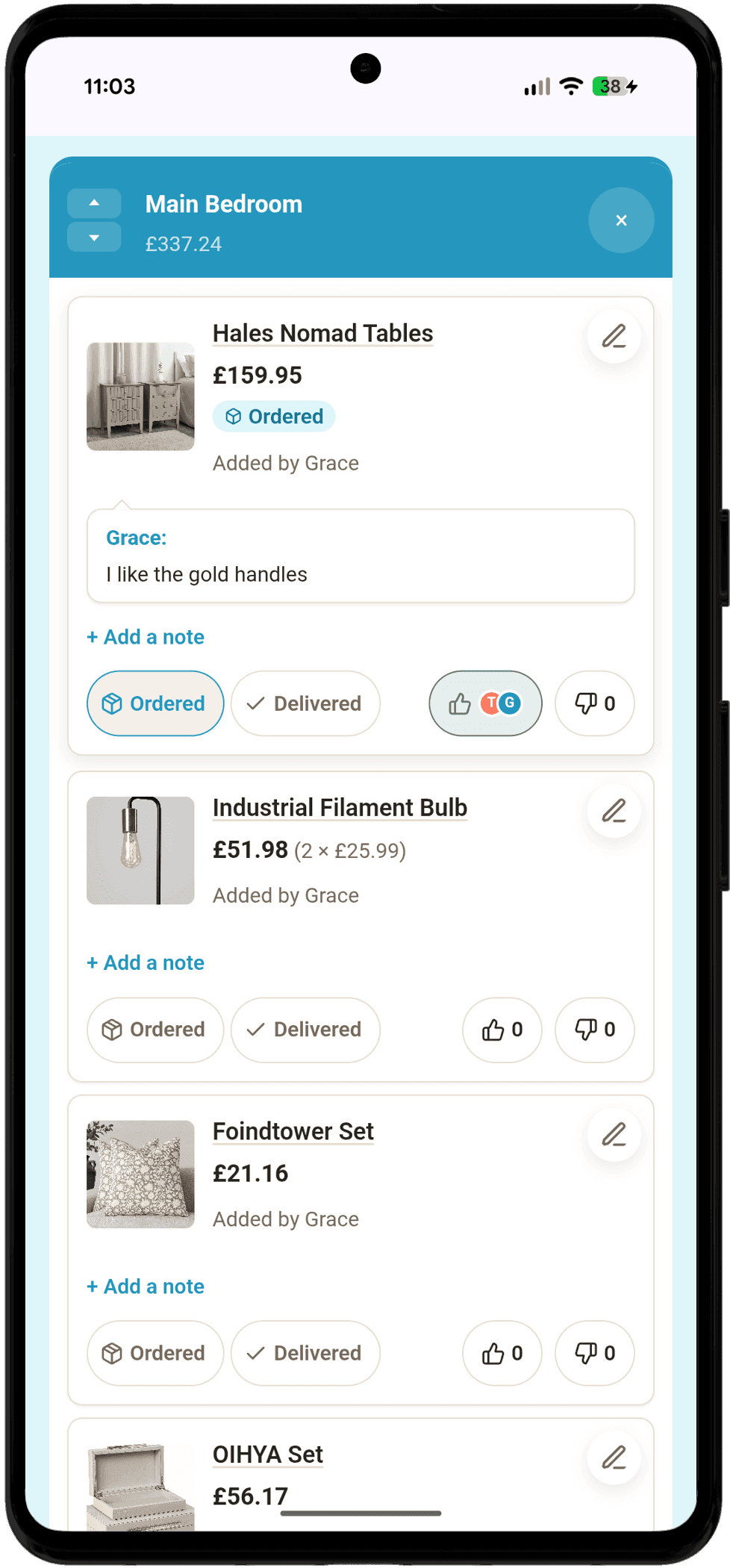
A normal wishlist app assumes one person is deciding.
A furniture wishlist app built for couples assumes two people need to see the same items, react to them separately, and end up with a shared answer, not just a shared list.
You can, but most shopping wishlists (Amazon's included) are single-retailer and single-account.
Furniture shopping as a couple is usually cross-retailer and two-person, which is exactly what those tools weren't built for.
Not with Furnish Together. You get one private link when you create the list, and that link is what both of you use. No accounts to set up or passwords to share.
That's what the voting is for. Each of you gives a thumbs up or down independently, so a disagreement shows up clearly as a disagreement, rather than being smoothed over because one of you didn't want to say anything.
Yes, arguably more so. A handful of rooms with real budget pressure is exactly where losing track of one price or one agreed item causes the most friction, not less.
You should be able to, since most furniture browsing happens on a phone rather than a desktop. A tool that only works properly on a laptop isn't built around how couples actually shop.
Look for a tool that lets you mark something as undecided rather than forcing an immediate yes or no. A genuine maybe keeps items you're still weighing up visible, instead of burying them under ones you settled on ages ago.
Built for couples deciding together.
Six free wishlist tools people actually use, what each one gets right, and where it falls short if you're furnishing a home together

Different tastes, one budget and one sofa: how couples agree on furniture without it turning into a row, from setting the budget first to voting separately

A realistic order to buy things in, so you're not sleeping on a mattress on the floor for a month while you argue about a coffee table